

7 Reasons We Don’t Recommend Reverse Osmosis.
Reverse Osmosis Water: Are You Filtering Out Too Much?
Reverse osmosis sounds impressive.
Water gets forced through an extremely fine membrane. Many unwanted contaminants remain behind. Clean-looking water comes out the other side.
What could possibly be wrong with that?
Quite a lot, depending on your water supply and what you actually need.
Reverse osmosis has important uses. It can desalinate seawater. It can treat badly contaminated groundwater. It can remove certain contaminants that ordinary filters may not handle adequately.
However, most Australian households receive treated municipal water—not seawater.
For these homes, reverse osmosis may be an unnecessarily complicated solution. It can waste water, remove naturally occurring minerals and create ongoing maintenance problems.
Before buying an RO system, ask a simple question:
Are you improving your water—or stripping it bare?
What is reverse osmosis?
Reverse osmosis, usually called RO, uses water pressure to push water through a semi-permeable membrane.
The membrane separates the incoming water into two streams.
One stream becomes treated drinking water. The other carries rejected salts and contaminants down the drain.
RO can reduce many dissolved substances, including:
- Lead
- Arsenic
- Nitrate
- Fluoride
- PFAS
- Salts
- Some pesticides
- Many dissolved minerals
That broad removal ability makes RO useful for difficult water sources.
But RO is not selective. It cannot carefully separate everything you dislike from everything you want.
It removes beneficial minerals along with unwanted contaminants.
Problem one: RO wastes water

Every reverse-osmosis system produces wastewater.
Older or inefficient household units can send several litres down the drain for every litre of drinking water produced.
The US Environmental Protection Agency estimates that a typical point-of-use RO system may waste at least five litres for each litre of treated water. Some inefficient systems may waste ten.
New, efficient RO systems perform better. However, they still create a reject-water stream.
That matters in Australia.
We live on the driest inhabited continent. Many households pay for every litre entering their property. It seems odd to purchase treated municipal water, send much of it down the drain, and then pay to filter what remains.
The UltraStream takes a different approach.
Water passes through the filter and into your glass. There is no reject-water line and no stream running down the drain.
Problem two: RO removes minerals

Reverse osmosis greatly reduces total dissolved solids. This includes calcium, magnesium and other naturally occurring minerals.
Let’s be accurate here.
Most people obtain most of their minerals from food. Drinking RO water does not automatically cause a mineral deficiency.
However, that does not mean removing the minerals is always desirable.
Minerals influence:
- Taste
- Water hardness
- Alkalinity
- Mouthfeel
- Corrosion behaviour
- The balance of the finished water
RO water often tastes flat because most dissolved minerals have disappeared.
Many RO companies recognise this problem. They add another cartridge after the membrane to put minerals back into the water.
Think about that.
The system first removes nearly everything. It then attempts to replace selected minerals afterwards.
Why remove useful minerals when a suitable filter could retain or rebalance them in the first place?
Problem three: RO systems are complicated
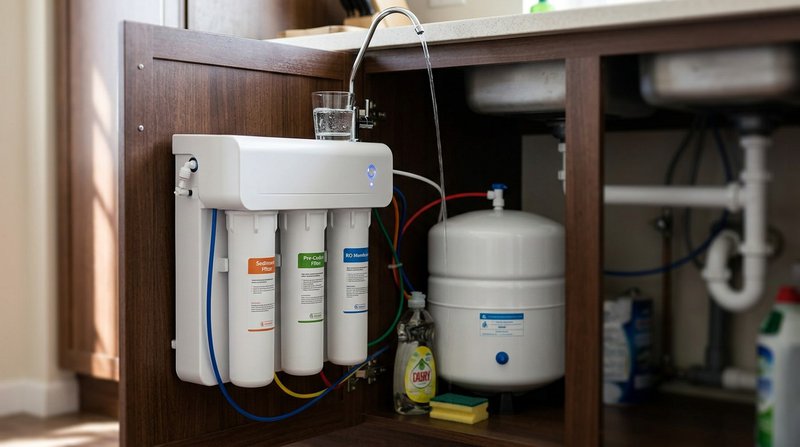
A typical under-sink RO system may contain:
- Sediment filtration
- One or more carbon filters
- An RO membrane
- A pressurised storage tank
- A flow restrictor
- A drain connection
- A separate drinking-water tap
- A remineralisation cartridge
- Numerous tubes, valves and connectors
Each component creates another possible maintenance point.
Filters need changing. Membranes eventually require replacement. Tanks need checking. Low water pressure can reduce performance. Incorrect servicing can affect water quality.
Water may also remain inside the storage tank between uses.
This does not make every RO system unsafe. It means proper installation and maintenance matter.
The UltraStream is much simpler. It filters water as you use it, without an RO membrane, wastewater connection or pressurised storage tank.
Problem four: RO may be more treatment than you need.

The correct filter should match the actual problem.
If testing shows high salinity, arsenic, nitrate or another difficult dissolved contaminant, reverse osmosis may be appropriate.
However, most people buy an RO system without first testing their water.
They assume that removing virtually everything must provide the safest result.
That is not always logical.
A properly selected filtration system can target relevant contaminants while avoiding the waste and complexity of reverse osmosis.
Activated and catalytic carbon can reduce chlorine, chloramines and many organic chemicals. Specialised media can address heavy metals and fluoride. Additional pre-filters can be added when local water presents a particular problem.
Treatment should fit the water—not the fear.
How is the UltraStream different?

The UltraStream is a natural, non-electric water filter and ioniser.
It does not force water through a membrane. It uses carefully selected filtration and conditioning media to reduce unwanted contaminants while adding or retaining beneficial mineral characteristics.
The UltraStream:
- Uses no electricity
- Produces no reject water
- Requires no storage tank
- Uses natural mineral media
- Reduces chlorine and chloramines
- Reduces heavy metals and many other contaminants
- Reduces approximately 80% of fluoride under tested conditions
- Adds calcium and magnesium
- Produces mildly alkaline water
- Infuses up to 0.8 ppm molecular hydrogen
- Operates directly from your tap
- Has a tested capacity of up to 3,000 litres
Performance always depends on the incoming water, flow rate and cartridge condition.
The cartridge normally lasts about 12 months for an average household. Replacing it takes only a few minutes.
There is no membrane to service and no wastewater pipe to install.
What about PFAS?
Reverse osmosis can reduce PFAS. That is one of its genuine strengths.
However, it is not the only technology that can do so.
The US EPA reports that properly selected activated carbon, ion-exchange and RO systems can all greatly reduce PFAS. Effectiveness depends on the particular contaminant, filter design, water conditions and timely cartridge replacement.
For homes with a known PFAS problem, AlkaWay offers a specialised PFAS pre-filter that can be installed with the UltraStream.
Claims should always be supported by testing for the particular filter and contaminant. No filter should be treated as magical.
When would we recommend reverse osmosis?
We would consider RO when testing confirms a problem that requires membrane treatment.
Examples may include:
- High salinity
- Seawater or brackish water
- Excessive nitrate
- Serious arsenic contamination
- Particular industrial contaminants
- Water unsuitable for ordinary flow-through filtration
In these situations, RO may be the right tool.
It may also be sensible to remineralise the treated water afterwards.
But for ordinary treated Australian tap water, we believe RO is often unnecessary.
The simple choice

Reverse osmosis begins with a scorched-earth approach.
It removes almost everything, wastes part of the incoming water and may then require another cartridge to replace some of what was removed.
The UltraStream takes a more balanced approach.
It reduces a broad range of unwanted substances, introduces alkaline minerals and molecular hydrogen, and delivers the water directly to your glass.
No electricity.
No storage tank.
No reject stream disappearing down the drain.
No complicated membrane system.
Reverse osmosis certainly has its place. But that place should be decided by the water problem—not by the belief that removing absolutely everything must always be better.
For most Australian households, we believe the UltraStream offers a simpler, less wasteful and more enjoyable approach to drinking water.