

Is This Snake Oil or the Best Water Available?

If you’re like me when you hear:reverse osmosis water.You’re probably like, what the hell?!
Is this just some pointless tech and fancy jargon?With no real science to support it?
Water is water, right?Why mess with it? Well, unfortunately, our environment is incredibly polluted.And the water we use everyday could be contaminated with all sorts of nasty compounds.So it does beg the question: how can we purify it? Reverse osmosis water systems might offer a solution.
But, at what cost? Literally.
And what else are they filtering out of the water?Let’s get to the bottom of this.
And take a closer look at how reverse osmosis works, what it removes, and whether it’s truly worth the investment.
What is Reverse Osmosis Water?
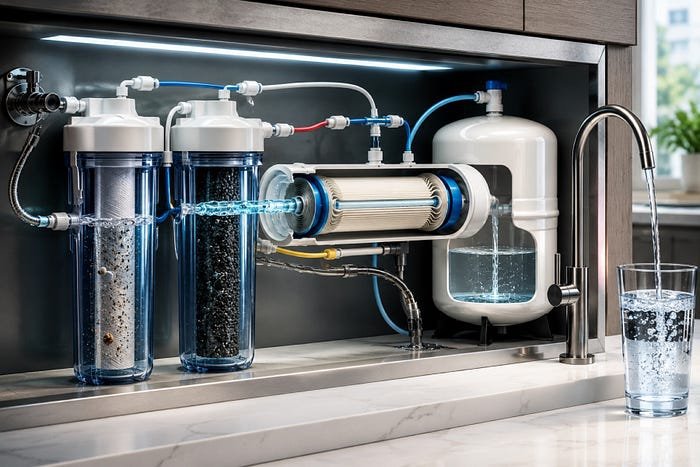
The name itself sounds more complicated than it really is.Let’s break it down.Osmosis is a natural process in which water moves through a semipermeable membrane from an area of lower concentration to an area of higher concentration.It’s something that happens constantly in nature and inside living cells.Reverse osmosis does the opposite.Instead of allowing water to move naturally, pressure is applied to force water through the membrane in the reverse direction.
As the water passes through, many contaminants are left behind.In simple terms, reverse osmosis uses pressure, and a specialized membrane, to separate clean water from unwanted substances.The system is complex and contains many parts.But at the heart of the system is a semipermeable membrane.This membrane contains microscopic pores that allow water molecules to pass through, while blocking many unwanted substances.
As water moves through the system, contaminants such as:
• sediment
• chlorine
• heavy metals
• PFAS
• nitrates
• and microplastics
may be reduced or removed.
The result is highly purified water that many people consider cleaner, better tasting, and more consistent than ordinary tap water.This is one reason reverse osmosis systems are gaining notoriety. And are more common in homes, offices, and healthcare settings.But while the concept is relatively simple, the technology behind it is surprisingly sophisticated.To understand why reverse osmosis is so effective, let’s take a deeper look at the system itself.
How Do Reverse Osmosis Systems Work?
While reverse osmosis systems can vary slightly in design, most follow the same basic process.Water enters the system and passes through a series of filters before reaching the reverse osmosis membrane. Each stage has a specific job:
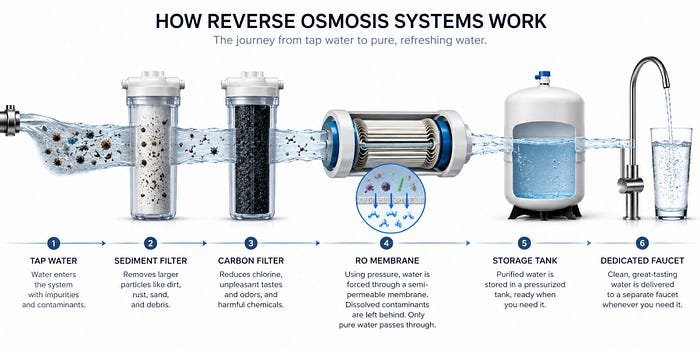
- Sediment Filter
The first stop is usually a sediment filter. This filter removes larger particles such as dirt, rust, sand, and other debris.Think of it as the system’s first line of defense.
2. Carbon Filter
Next, the water passes through a carbon filter.Carbon is particularly effective at reducing chlorine, odors, and compounds that can affect taste. This stage also helps protect the reverse osmosis membrane from damage.
3. Reverse Osmosis Membrane
This is where the real magic happens. Under pressure, water is forced through a semipermeable membrane containing microscopic pores. Water molecules can pass through, but most contaminants can’t.This is the stage responsible for removing a significant percentage of dissolved impurities, including heavy metals, PFAS, nitrates, and other unwanted substances.
4. Storage Tank
The purified water is then stored in a pressurized tank.This allows the system to provide clean water on demand rather than filtering it slowly every time you turn on the faucet.
5. Dedicated Faucet
When you need a glass of water, the purified water travels from the storage tank to a separate faucet installed on the sink.The result is clean, filtered water that has passed through multiple layers of purification before reaching your glass.But, are they too good at filtering?
Could these systems also filter out beneficial compounds such as minerals and electrolytes?
Does Reverse Osmosis Remove Beneficial Minerals?
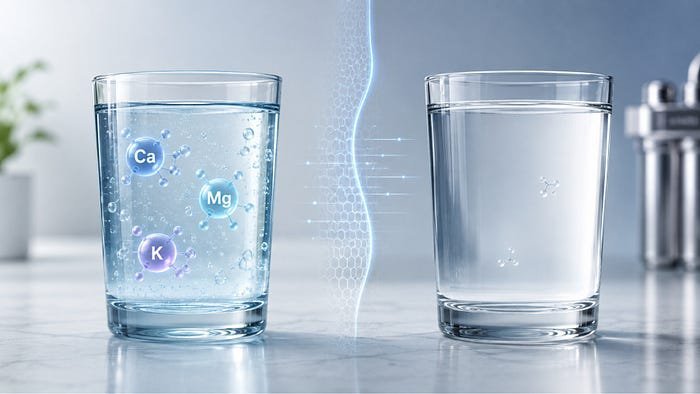
Unfortunately…Yes.
Reverse osmosis doesn’t distinguish between substances you want in your water and substances you don’t. Along with contaminants, the membrane can also remove naturally occurring minerals such as:
-calcium
-magnesium
-and potassium
This is one of the most common criticisms of reverse osmosis water.And, it’s a completely valid one.
But it may also be a little overblown.
For most people, drinking water isn’t the primary source of essential minerals.
Calcium, magnesium, potassium, and other nutrients are generally obtained in much larger amounts from food. Or supplements such as daily vitamins and electrolytes powder. So yes: reverse osmosis water contains fewer minerals.But that doesn’t automatically make it nutritionally inferior or unhealthy.
There’s another consideration, though.
Removing dissolved minerals can change the taste of water. Which sometimes gives reverse osmosis water a flatter or less distinctive flavor. That’s why some newer systems include a remineralization stage. Which adds small amounts of minerals back into the water after filtration.
The more important question is:
whether losing those minerals matters enough to outweigh the benefits of removing unwanted contaminants. For most people, that’s a tradeoff worth considering.
Benefits of Reverse Osmosis Water
So what are the actual advantages of drinking reverse osmosis water?
There are several.
Reduces a Wide Range of Contaminants
We covered this already but it’s worth repeating and expanding on. Because this is huge.And it’s unquestionably the biggest advantage.Reverse osmosis can significantly reduce many substances that may be present in drinking water, including:
•lead
•arsenic
•nitrates
•fluoride
•PFAS
•and other dissolved contaminants
The exact amount removed depends on the system, membrane, and contaminants involved.But compared with many basic household filters, reverse osmosis offers a much broader level of filtration.
May Reduce Exposure to PFAS

PFAS, sometimes called “forever chemicals,” have become a growing concern in drinking water. As the name implies, these chemicals are extremely persistent. And have been detected in water supplies throughout the United States. Reverse osmosis is one of the filtration methods capable of substantially reducing certain PFAS compounds. For people living in areas where PFAS contamination is a concern, that alone may make an RO system worth considering.
Removes Lead and Other Heavy Metals
Lead can enter drinking water through aging pipes, plumbing fixtures, and service lines. And unlike some water quality issues, you can’t reliably detect it by taste, smell, or appearance. Reverse osmosis systems can significantly reduce lead along with metals such as arsenic and chromium.
Improves Taste and Odor

Not every reason to filter water has to involves incredibly harmful chemicals. Chlorine, dissolved solids, and other compounds can affect how tap water tastes and smells. Because reverse osmosis systems typically combine membrane filtration with carbon filtration, many people find that the water tastes cleaner. And if better-tasting water encourages you to drink more of it, that’s a practical benefit in itself.
Provides Consistent Water Quality at Home
Municipal tap water is regulated, but its composition can still vary depending on:
• where you live
• your local water source
• and even the plumbing inside your home
A reverse osmosis system adds another layer of control. Instead of relying entirely on the water arriving at your tap, you’re filtering it immediately before you drink it.
May Reduce Reliance on Bottled Water
Bottled water is ubiquitous these days. Everyone is walking around, sipping from it intermittently. And that usually means buying them in bulk once or twice a week. Or buying individual bottles randomly. Which can be surprisingly expensive. For people who regularly buy bottled water because they dislike or distrust their tap water, a home reverse osmosis system can provide a convenient alternative. That can mean fewer plastic bottles, fewer trips to the store, and potentially lower costs over the long term. While also ingesting far less micro plastics. Taken together, these advantages make a compelling case for reverse osmosis.
But there’s another side to the equation.
These systems also come with costs, maintenance requirements, and a few legitimate drawbacks that are worth understanding before buying one.
Potential Drawbacks of Reverse Osmosis Water
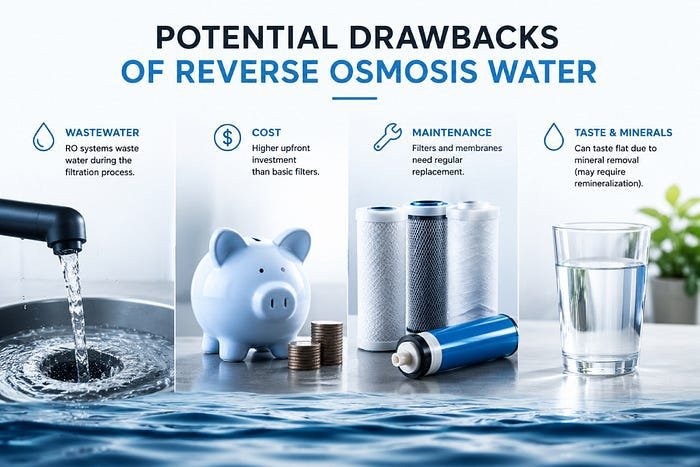
Reverse osmosis is a great innovation.But it isn’t perfect.
Before investing in a system, there are a few drawbacks worth considering.
It Wastes Water
Reverse osmosis systems don’t convert every gallon of incoming water into drinking water. Some water is used to carry rejected contaminants away from the membrane and down the drain. How much depends heavily on the system. Older and less efficient systems can waste considerably more water. While newer high-efficiency models may perform much better. If water conservation is important to you, this is one specification worth checking before you buy.
Higher Upfront Cost

P basic pitcher or faucet filter is relatively inexpensive. A reverse osmosis system on the other hand…is a bigger investment. Numbers vary but most estimates put it somewhere between $1K and $4K.You’ll need to account for the system itself, and potentially installation if you’re not comfortable installing it yourself.More advanced systems with pumps, remineralization stages, or additional filtration can cost even more.
Filters Need to Be Replaced
RO systems aren’t something you install and forget about. Sediment filters, carbon filters, and eventually the membrane itself need to be replaced. Exactly how often depends on the system, your water quality, and how much water you use.But you absolutely can’t neglect the maintenance.That will reduce performance and lead to a total breakdown eventually.
The Water May Taste Different

Yes, we covered this in the last section. Because for some people it’s great. And for others…not so much. Because reverse osmosis removes dissolved minerals, some people find the water tastes unusually neutral or slightly “flat.” Others prefer it. It’s a matter of taste. If you prefer the taste of mineral-rich water, a system with a remineralization stage may be a better option.
It May Be More Filtration Than You Need
This is perhaps the most overlooked drawback. Not everyone needs reverse osmosis.If your tap water is already high quality and your primary concern is chlorine or taste, a much simpler carbon filter may accomplish what you want. And for far less money and with less maintenance. Reverse osmosis makes the most sense when you actually want the broader filtration it provides. And that brings up an important question:
How does reverse osmosis compare with the other water filtration options available?
Reverse Osmosis vs. Other Water Filters
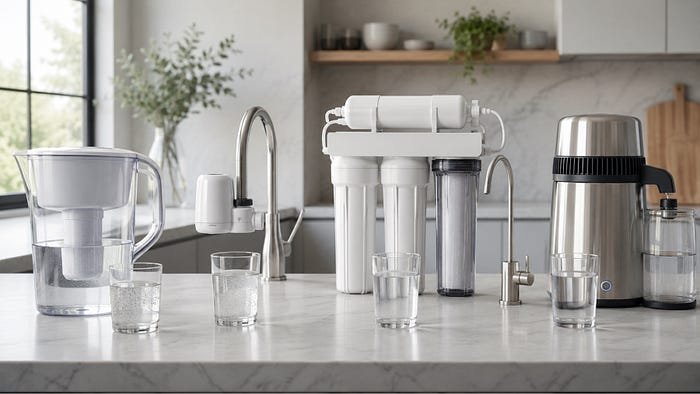
Reverse osmosis isn’t the only game in town. There are some other interesting choices in the market. Depending on what you’re trying to remove, a simpler — and cheaper — filter may be all you need. Here’s how the major options compare:
Carbon Filters
Activated carbon is one of the most common forms of household water filtration. You’ll find it in many pitchers, refrigerator filters, and faucet-mounted systems. Carbon filters are particularly good at reducing chlorine and compounds that affect taste and odor. Some certified carbon filters can also reduce certain contaminants such as lead and PFAS. But they generally aren’t as effective as reverse osmosis at removing a broad range of dissolved substances. For someone whose main complaint is that their tap water tastes or smells bad, carbon filtration may fit the bill.
Water Filter Pitchers
Pitchers are inexpensive, convenient, and require no installation. Most rely primarily on activated carbon.Although more advanced versions may use additional filtration media. Their biggest advantages are simplicity and cost.Their limitation is that their performance varies dramatically from one product to another.A pitcher can be a great option for basic filtration.But you shouldn’t assume it removes a particular contaminant unless the manufacturer has actually tested and certified it for that purpose.
Reverse Osmosis
You know a lot about this by now.Reverse osmosis goes considerably further.Because it uses a semipermeable membrane in addition to prefilters, it can reduce many dissolved contaminants that basic carbon filters may leave behind.That broader filtration is its biggest advantage.The tradeoff, as you know, is higher cost, more maintenance, some wastewater, and the removal of naturally occurring minerals.
Distillation

Distillation takes a completely different approach.Water is heated into steam and then condensed back into liquid, leaving many contaminants behind.It can produce extremely purified water.But countertop distillers can:-be slow-consume electricity-and aren’t convenient when you need larger amounts of drinking water throughout the day.
So Which Is Best?
There isn’t one filter that’s best for everyone.If you’re mainly concerned about chlorine and taste, a good carbon filter may be enough.If you want broad reduction of dissolved contaminants such as lead, nitrates, arsenic, or certain PFAS, reverse osmosis is the winner.And if extremely purified water is the goal, distillation is another option.The smartest approach is to start with a simpler question:
What’s actually in your water — and what do you want to remove?
Once you identify that, choosing the right filtration system becomes an easy choice.
Is Reverse Osmosis Water Worth it?

Unless you live in the country in a pristine environment (such areas DO still exist, albeit they are becoming increasingly more rare), reverse osmosis is probably not for you.However, for the rest of us, they’re definitely worth considering.
They’re an investment. But they’re an investment in your health. Water is foundational so you want the cleanest water you can get. Or, even if you don’t want the full system, look for brands who sell reverse osmosis water. They’re in almost every market, corner store, and gas station.Our environment is polluted. And we have to do something about it.Reverse osmosis is one of the ways to doing that.